

Linear Perceptron Model
Linear Perceptron Algorithm
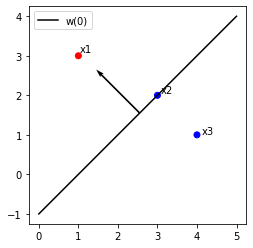
The purpose of this project was to break down the linear perceptron algorithm step-by-step to demonstrate how it works. In order to do this, I set up three training samples in a 2D space. These samples are:
- Sample with coordinates (1, 3) belonging to Class 1 ( = 1)
- Sample with coordinates (3, 2) belonging to Class 2 ( = −1)
- Sample with coordinates (4, 1) belonging to Class 2 ( = −1)
For this project, the linear perceptron is initialized with a line with corresponding weight (this can also be written as the line ).
To start off, I simply plotted , , and , the starting weight line w(0) and the direction of the weight w(0) on the line. I also defined two functions, one for plotting these three things and another for computing dot product for the next part of the project.
# function for plotting the sample points, weight line
# and the direction of the weight

def plot_graph(x, y, sample_names, colors, x0, y0, u, v, label_name):
    # plot points
    fig, ax = plt.subplots()
    ax.scatter(x, y, c=colors)
    for i, txt in enumerate(sample_names):
        ax.annotate(txt, (x[i] * (1.03), y[i]* (1.03)))

    # plot weight line
    plt.plot(x0, y0, '-k', label=label_name)
    plt.legend()

    # plot weight direction
    plt.quiver(x0[25], y0[25], u, v, scale=5)
    ax.set_aspect(1./ax.get_data_ratio())
# function for computing dot product and printing results
def inner_product(line, samples, line_name):
    for i in np.arange(3):
        print("The inner product of " + line_name + " and x" + str(i+1) + ":", np.dot(line, samples[i]))
# data for samples x1, x2, x3
x = [1, 3, 4]
y = [3, 2, 1]

sample_names = ['x1', 'x2', 'x3']
colors = ['red' if i == 1 else 'blue' for i in x]
# data for line corresponding to weight w(0)
x0 = np.linspace(0,5)
y0 = x0-1

# plot data points and weight line w(0) with direction
plot_graph(x, y, sample_names, colors, x0, y0, -1, 1, 'w(0)')
For the next step, I used the rule , to determine which samples were correctly and incorrectly classified using the weight w(0). To do this, I first wrote the data points and weight as vectors and then computed the inner product between the weight and each sample to see which samples were misclassified (based on the inner product being greater or less than zero).
# data points as vectors
x1 = np.array([1, 1, 3])
x2 = np.array([1, 3, 2])
x3 = np.array([1, 4, 1])
samples = [x1, x2, x3]

# weight line as vector
w0 = np.array([2, -1, 1])

# inner product of weight line w(0) and data samples
inner_product(w0, samples, 'w0')
The inner product of w0 and x1: 4
The inner product of w0 and x2: 1
The inner product of w0 and x3: -1
In this case, the inner product of w(0) and should be greater than zero because is part of class 1 and the inner products of w(0) and as well as w(0) and should both be less than zero because they’re in class 2. Going off of this, and are correctly classified while is not correctly classified.
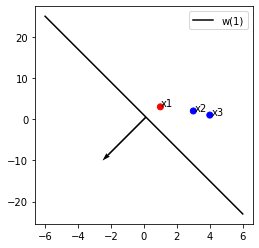
After this, I used the weight update rule from the linear perceptron algorithm, to find the value of the new weight w(1) based on the misclassified sample. I then plotted the new line corresponding to weight w(1), as well as the direction of the weight on the line.
Note: The update rule is , where and is the feature and class label of misclassified sample s.
# w(1) = w(0) + ys * xs
# where:
# w(0) = [2, -1, 1]
# ys = -1
# xs = x2

# weight update rule to get w(1)
w1 = np.array(w0 - x2)
print("New weight w(1) =", w1)
New weight w(1) = [ 1 -4 -1]
# data for line corresponding to weight w(1)
x0 = np.linspace(-6,6)
y0 = 1-4*x0

# plot data points and weight line w(1) with direction
plot_graph(x, y, sample_names, colors, x0, y0, -1, -1, 'w(1)')
# inner product of weight line w(1) and data samples
inner_product(w1, samples, 'w1')
The inner product of w1 and x1: -6
The inner product of w1 and x2: -13
The inner product of w1 and x3: -16
Again, the inner product of w(1) and should be greater than zero because is part of class 1 and the inner products of w(1) and as well as w(1) and should both be less than zero because they’re in class 2. Going off of this, and are correctly classified while is not correctly classified.
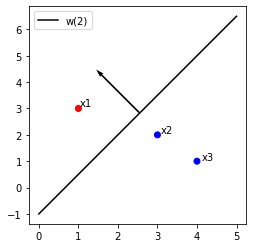
Now, we use the rule to run the linear perceptron algorithm until it converges, which in this case only takes one more iteration.
# weight update rule to get w(2)
w2 = np.array(w1 + x1)
print("New weight w(2) =", w2)
New weight w(2) = [ 2 -3 2]
# data for line corresponding to weight w(2)
x0 = np.linspace(0,5)
y0 = -1+(3/2)*x0

# plot data points and weight line w(2) with direction
plot_graph(x, y, sample_names, colors, x0, y0, -1, 1, 'w(2)')
# inner product of weight line w(2) and data samples
inner_product(w2, samples, 'w2')
The inner product of w2 and x1: 5
The inner product of w2 and x2: -3
The inner product of w2 and x3: -8
After the algorithm converges, all the samples are now correctly classified.